
Quick Summary
Key Features
- Crypto in, EUR out
- Apple Pay & Google Pay
- Multiple cards per account
- 1.6% crypto top-up fee, no transaction fee
Main Advantages
- Works with Apple Pay and Google Pay
Notable Limitations
- Paid issuance: €6
- Recurring fee: €1
- Availability limited to a small number of regions
- Terms change often — the provider's live numbers are final
The cards
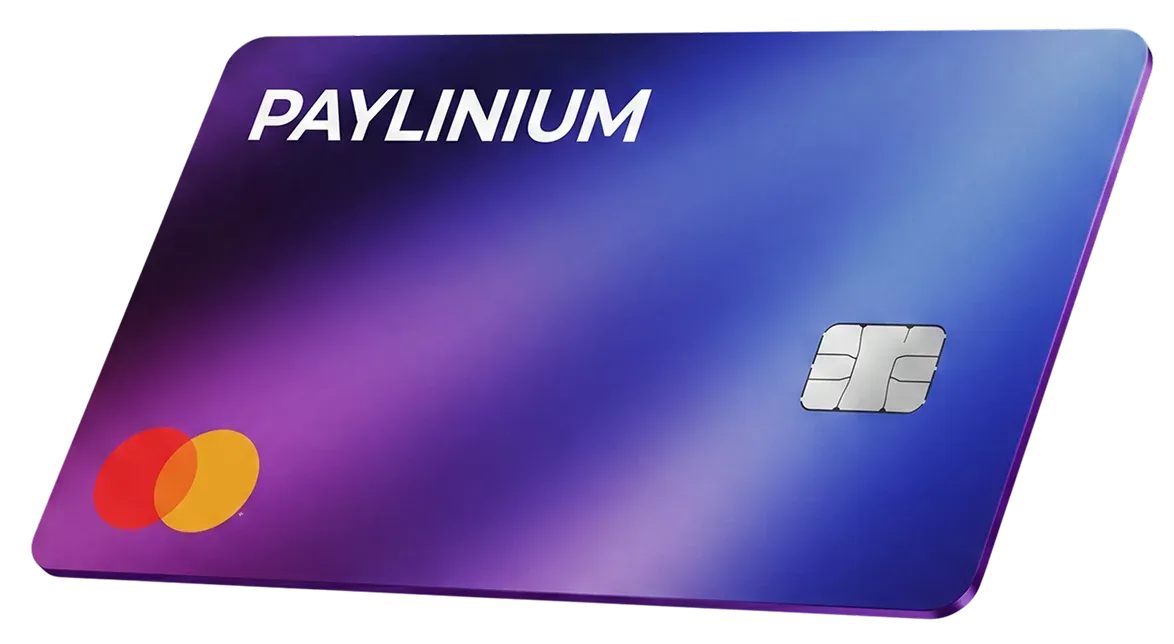
Every format Paylinium issues — pick the one that fits how you spend.
1Can I get this card?
Supported Countries Map — powered by our availability data.
Paylinium: Reported in 27 countries across 1 region (Europe).
Coverage reported by the provider — the exact applicant list is confirmed in-app.
2What does it cost?
Every fee we could verify for the Paylinium card.
Fees verified October 13, 2026 from public web sources. Fees change often — always confirm the app's live numbers before signing up. This page is for information only, not financial advice.
| Fee | Paylinium |
|---|---|
| Issuance fee | €6 |
| Monthly fee | €1 |
| FX fee | Varies by region — confirm in-app |
3What do I get?
Perks, rewards and capabilities that come with the card.
| Category | Benefit |
|---|---|
| Perks | Crypto in, EUR out |
| Mobile wallets | Apple Pay & Google Pay |
| Perks | Multiple cards per account |
| Funding | 1.6% crypto top-up fee, no transaction fee |
4What do they need from me?
What you will have to provide or meet to get and use the card.
| Requirement | What it means |
|---|---|
| Identity check | ID verification required — verify your identity in the app before ordering |
| Funding | You will need a way to load the card: USDT, USDC, BTC, ETH |
| Age | You must be 18 or older to apply |
What is Paylinium?
Paylinium is a crypto-funded virtual Mastercard built around a simple idea: top up with crypto, spend like a normal cardholder. The card settles in EUR, supports Apple Pay and Google Pay, and works anywhere Mastercard is accepted — online or in-store. There are no exotic features here, no yield programs, no loyalty tiers. It is a straightforward bridge between a crypto balance and everyday spending, and for many users that simplicity is exactly the appeal.
The pricing is equally plain: a EUR 6 one-time issuance fee, EUR 1 per month, no per-transaction fee, and a 1.6% fee on crypto top-ups. Everything is disclosed up front, which is more than can be said for several competitors in this space that hide fees behind vague "network charges." You know what you are paying before you start.
Paylinium's natural audience is anyone who earns or holds crypto and wants to spend it without first converting to fiat on an exchange and withdrawing to a bank. Freelancers paid in USDT, traders taking profits in BTC or ETH, and international shoppers who keep a crypto float will find the model familiar. The multi-card support also makes it a practical pick for people who run ad accounts or manage subscriptions across several projects and want a separate card number for each.
Card types offered
Paylinium issues virtual Mastercards, and its standout feature is that you can hold multiple cards per account. Each card gets its own number, which makes it easy to compartmentalize spending: one card for subscriptions, one for ad spend, one for general online shopping. If a card number is compromised or a free trial starts billing unexpectedly, you can kill that card without touching the others — a meaningful security and budgeting advantage over single-card setups.
Because the cards are virtual, issuance is fast and there is no plastic to wait for or lose. They work for all online payments wherever Mastercard is accepted, and through Apple Pay and Google Pay they also work for contactless in-store payments from your phone. There is no physical card option in the current offering, so if you need ATM cash withdrawals or a plastic card for travel, you will need a second product alongside Paylinium.
Settlement is in EUR. That is worth understanding clearly: your balance is denominated in euros, and spending in USD, GBP, or any other currency involves conversion from EUR at the card network's rates. For users based in Europe this is transparent and convenient; for users elsewhere it adds a conversion step to every non-EUR transaction. It does not make the card unusable outside the eurozone, but it does mean EUR-based pricing is the natural home for this product.
Fees explained
Paylinium's fee schedule is short and fully disclosed. Here is each component.
Card issuance fee
Each virtual card costs EUR 6 as a one-time issuance fee. Because multiple cards per account are allowed, the issuance fee applies per card — three cards means three issuance fees. At roughly the price of a coffee per card, this is modest, and it is a one-time cost rather than a recurring one.
Monthly fee
The monthly fee is EUR 1. This is the main recurring cost of the product and the main thing to weigh against free alternatives. Over a year it totals EUR 12 per card on top of issuance. For active users who value the multi-card setup and crypto-native top-ups, it is a small price; for someone who would use the card twice a year, a no-monthly-fee competitor may be cheaper overall.
FX / conversion fee
Paylinium does not advertise a separate FX markup; the card settles in EUR and non-EUR spending converts at the card network's exchange rates. Mastercard's wholesale rates are generally fair, but they are not zero — expect the usual small spread baked into the conversion. If the majority of your spending is in EUR, this is a non-issue.
Top-up fees
Crypto top-ups carry a 1.6% fee. This is the fee that adds up: topping up the equivalent of $1,000 costs you $16 before you spend a cent. Heavy users should factor this into every comparison — a card with a higher monthly fee but free top-ups can easily come out cheaper at volume. On top of the 1.6%, you also pay the blockchain network fee for sending crypto to your Paylinium deposit address, so topping up small amounts frequently is the most expensive possible pattern. Larger, less frequent top-ups minimize the damage.
ATM fees
Paylinium is a virtual-only product with no physical card, so ATM withdrawals are not part of the offering. If cash access matters to you, pair it with a card that issues plastic.
How to get a Paylinium card
- Sign up on the Paylinium website or app with your email address.
- Complete identity verification. As a card issuer, Paylinium requires KYC — typically a government ID and proof of address — before a card can be issued.
- Order your virtual card and pay the EUR 6 one-time issuance fee.
- Top up with crypto. Send USDT, USDC, BTC, ETH, or TRX to your deposit address. Remember the 1.6% top-up fee plus the network fee, and confirm the live numbers in the app.
- Add the card to Apple Pay or Google Pay for contactless spending, and start using the card number for online payments.
- Order additional cards from the same account if you want separate numbers for subscriptions, ads, or projects — each carries its own EUR 6 issuance fee.
Top-up methods
Paylinium is funded exclusively with cryptocurrency: USDT, USDC, BTC, ETH, and TRX. There is no bank transfer or debit-card top-up — the product assumes you already hold crypto somewhere. The practical implication is a two-step cost on every top-up: the 1.6% Paylinium fee plus the blockchain network fee for the transfer itself.
Stablecoins (USDT, USDC) are the sensible default for most users because their value does not move between the moment you top up and the moment you spend. Topping up with BTC, ETH, or TRX exposes you to price swings in between — fine if you are deliberately spending from a volatile holding, risky if you just want a predictable balance. The 1.6% fee applies regardless of which asset you use, so there is no fee advantage to picking one coin over another; choose based on what you hold and how much you trust its short-term stability.
One practical note on cost control: because the 1.6% fee applies to every top-up, the blockchain network fee — charged per transfer — becomes the variable you can actually optimize. Topping up $200 five times incurs five network fees; topping up $1,000 once incurs one. Consolidating into fewer, larger top-ups on a cheap network like Tron keeps the fixed costs down. Think of the 1.6% as the price of the bridge and the network fee as the toll: you cannot avoid the first, but you can minimize the second.
Availability
Paylinium is reported to be available globally, and once issued, the card works anywhere Mastercard is accepted — which is effectively everywhere cards are taken, online and in-store via mobile wallets. That said, "global availability" for a card product always comes with fine print: KYC acceptance depends on your nationality and country of residence, and sanctioned or restricted jurisdictions will be excluded. Check the signup flow for your country before assuming access. Settlement in EUR also means the product experience is smoothest for users comfortable operating in euros.
Pros
- Simple, transparent pricing with no hidden fees
- Multiple cards per account
- Works anywhere Mastercard is accepted
- Apple Pay and Google Pay support
- No per-transaction fee
Cons
- EUR 1 monthly fee
- EUR-only settlement
- 1.6% crypto top-up fee adds up at volume
- No physical card option
Card specs
| Feature | Paylinium |
|---|---|
| Virtual card issuance | €6 |
| Monthly / annual fee | €1 |
| Card network | Mastercard |
| Card type | Virtual |
| KYC | ID verification required |
| Top-up methods | USDT, USDC, BTC, ETH, TRX |
| Supported assets | USDT, USDC, BTC, ETH |
| Regions | Europe |
Rating breakdown
Pros & cons
Pros
- Simple, transparent pricing with no hidden fees
- Multiple cards per account
- Works anywhere Mastercard is accepted
- Apple Pay and Google Pay support
- No per-transaction fee
Cons
- EUR 1 monthly fee
- EUR-only settlement
- 1.6% crypto top-up fee adds up at volume
- No physical card option
Frequently asked questions
How much does a Paylinium card cost?
A Paylinium virtual card costs EUR 6 as a one-time issuance fee, plus EUR 1 per month. There is no per-transaction fee, but crypto top-ups carry a 1.6% fee.
Which cryptocurrencies can I use to top up Paylinium?
Paylinium accepts top-ups in USDT, USDC, BTC, ETH, and TRX.
Can I have more than one Paylinium card?
Yes. Paylinium allows multiple cards per account, which is useful for separating spending across subscriptions, ads, or projects.
Does Paylinium work with Apple Pay and Google Pay?
Yes. Paylinium cards support both Apple Pay and Google Pay for contactless payments.
What currency does Paylinium settle in?
Paylinium settles in EUR. Spending in other currencies involves conversion from your EUR balance at card network rates.
Where is Paylinium available?
Paylinium is reported to be available globally, and the card works anywhere Mastercard is accepted. KYC acceptance depends on your country.
Our verdict
Paylinium is the honest workhorse of crypto-funded cards: transparent EUR 6 issuance, EUR 1 monthly, no transaction fees, multi-card support, and Apple/Google Pay compatibility. The 1.6% crypto top-up fee is the real cost center and punishes small frequent top-ups, while EUR-only settlement is a mild friction for non-European spenders. If you hold crypto and want separate card numbers for subscriptions, ads, or projects without fee surprises, it is a solid, predictable choice.
Get the Paylinium card
Apply directly with the provider — check current fees and availability for your country in their app.
Visit Paylinium's official site →Fees verified October 13, 2026. Always confirm live numbers in-app.
Similar cards
Kast Card
Free Standard tier with 1.5% USD cashback and zero USD spend/top-up fees, serving 170+ countries including the
COCA
Non-custodial card that bundles free SEPA banking, zero-fee swaps across 15+ chains, and up to 8% cashback.
Plasma One
Self-custodial stablecoin neobank paying up to 10% back on AI subscriptions — spend stablecoins, earn XPL and